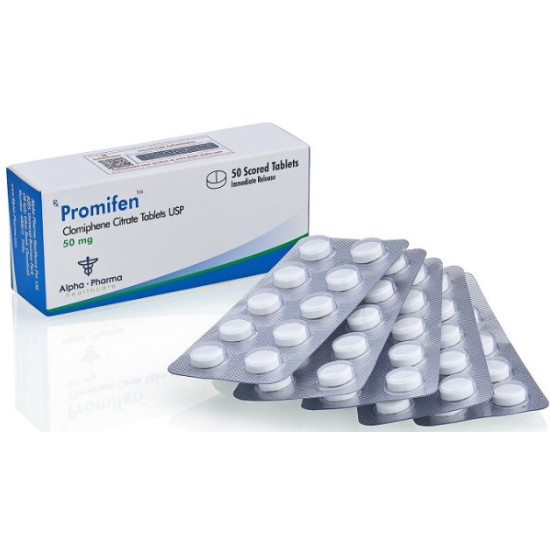
Promifen (Clomid) by Alpha-Pharma Healthcare is a synthetic
non-steroidal drug that is very similar in structure to estrogen. Promifen
(Clomid) is widely used as an ovulatory stimulant. Because of it's similarity
to estrogen, Promifen (Clomid) can bind to the estrogen receptors in the
hypothalamus. This blocks the hypothalamus from sensing "real"
estrogen and the hypothalamus in turn acts by stimulating the pituitary to
release more Gonadotropins like FSH and LH. The FSH and LH stimulate the
ovaries/testes to produce more estrogen/testosterone.
This property of Promifen (Clomid) has been widely used to treat women
with ovarian failure and induce ovulation. However, long term use of this drug
may not be safe because of the increase risk of ovarian cancer.
Promifen (Clomid) is a large molecule, which is soluble in most organic
solvents like alcohol. The sodium salt citrate is also soluble in water. The
chemical is odorless. Clomiphene comes as a 50 mg tablet. Patients who receive
Promifen (Clomid) must have been fully worked up for all gynecological and
endocrine disorders prior to therapy.
Ovulation typically occurs 5-10 days after starting Promifen. This
coitus should be timed to coincide with the expected time of ovulation. Clomid
is started out at 50 mg/day for 5 days. This dose can be increased in females
who do not ovulate.
Promifen (Clomid) is only taken once a day. Experts in the field of body
building suggest that it be used alone or in combination with low potency
anabolic steroids. Most body builders take anabolic steroids for a few months
and then switch over to Clomid. Promifen (Clomid) provides the surge in
testosterone and also prevents the development of breast enlargement. The exact
timing of when to start Clomid is not known but it is recommended that once the
steroid drugs are stopped, Promifen (Clomid) should be started within 7-10
days.
At the recommended doses for the short duration, Promifen (Clomid) is
generally safe. The majority of adverse reactions that occur are transient and
disappear once the treatment is stopped.
The most common side effects include the following: flushing, abdominal
discomfort, nausea, vomiting, breast tenderness, headaches, abnormal vaginal
bleeding, general fatigue, hair loss.
Anazole is a non-steroidal drug which is used to treat breast cancer. It
has been thoroughly studied in women with breast cancer between the 5th-8th
..